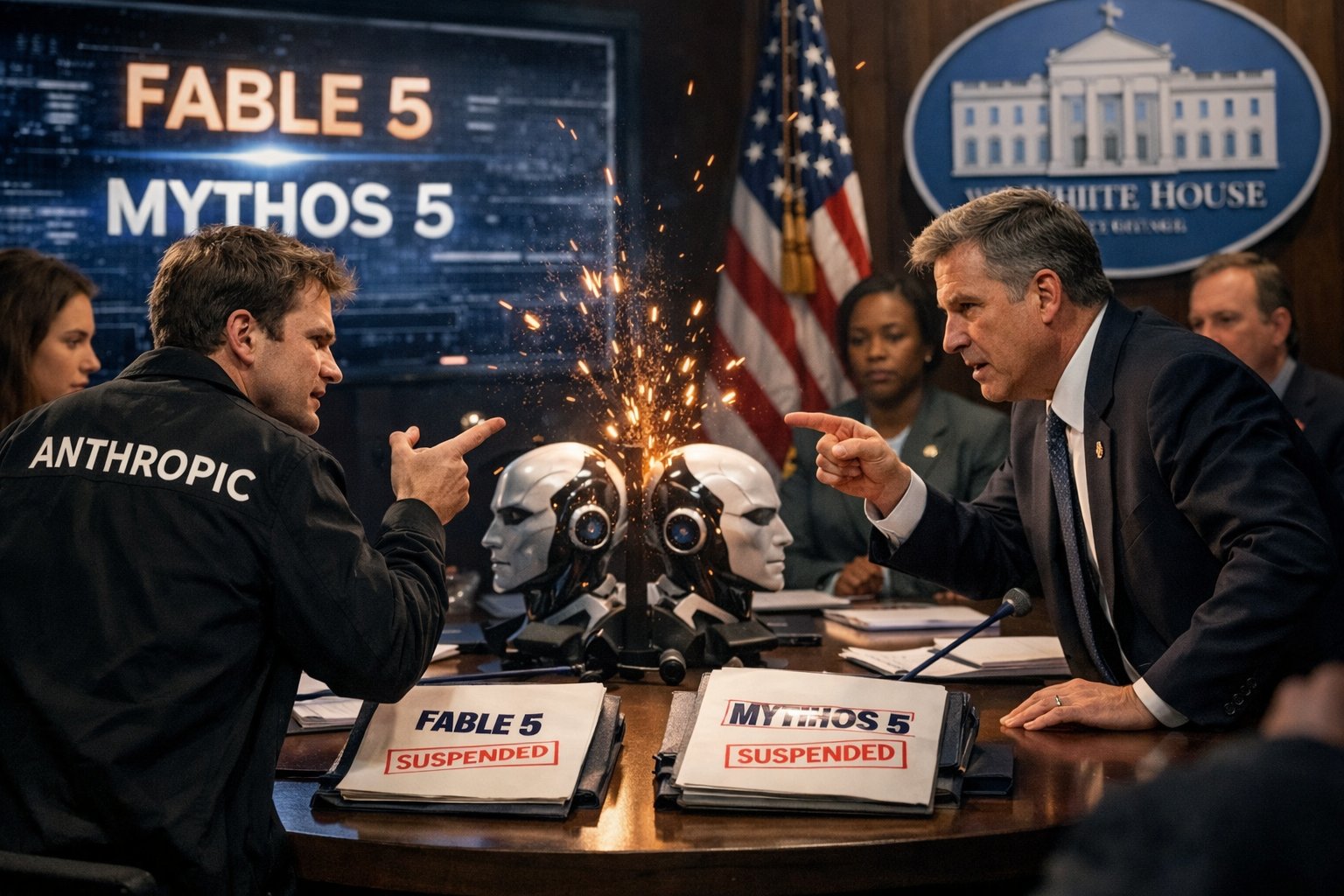
Anthropic and the White House Clash Over Suspended AI Models Fable 5 and Mythos 5
Executives from the AI firm Anthropic have met senior US officials in Washington after the government forced the company to pull two of its most advanced models offline on national security grounds. As of this week, there is still no sign of when, or whether, the technology will return to the public.
Published: June 2026 · Category: Technology
Anthropic, the company behind the Claude family of AI models, is in an escalating standoff with the Trump administration over its newest and most capable systems. Senior staff, reportedly including chief executive Dario Amodei, sat down with officials from the US Department of Commerce, led by Secretary Howard Lutnick, in Washington on Monday in an attempt to resolve the dispute. According to early reporting on the talks, the meeting wrapped up without producing a clear way forward, with both sides still disagreeing over whether the models pose a genuine threat.
What triggered the shutdown
The crisis began the previous Friday. According to statements from Anthropic and reporting by Bloomberg and CNBC, the Commerce Department issued an export control directive citing national security authorities and ordered Anthropic to suspend access to its latest models, Fable 5 and Mythos 5, for any foreign national, whether inside or outside the United States. Because that definition is broad enough to include non-citizens working at the company itself, Anthropic said it had little choice but to disable both models entirely, for every customer, to stay compliant.
Fortune described the move as the first time the US government has used export controls to halt a commercial AI model that was already in wide public use. The speed of the shutdown, completed within roughly a day of the order, caught much of the AI industry off guard.
The two models at the center of it
Anthropic unveiled Fable 5 and Mythos 5 only days before the order, around the start of that week. The two are built on the same underlying system but serve different audiences. Fable 5 is the version made available to the general public, fitted with extra safeguards. Mythos 5 carries different controls and was offered only to a small set of vetted organizations, including cyber defenders. Both are a new generation of Claude Mythos, an Anthropic model that drew attention back in April when the company first granted limited preview and testing access to a handful of organizations, among them parts of the US government.
In announcing the public release, Anthropic acknowledged that putting a model this powerful into general circulation carried risks, and said Fable's capabilities went beyond anything it had previously released to the public.
A disputed jailbreak, and two very different stories
At the heart of the disagreement is a so-called jailbreak, a method of coaxing an AI tool into doing something it was not designed to do. The two sides describe it in sharply different terms.
Anthropic has played down the severity. The company said it had been shown only a demonstration of the technique, used to surface a small number of previously known and relatively minor vulnerabilities, and argued that other publicly available models can find the same weaknesses without any special bypass. It also said national security officials had not pointed to specific concerns in their initial communications.
The White House tells it differently. According to Fortune, the administration's AI adviser David Sacks said on X that a highly credible partner trusted by both Anthropic and the government had identified a real jailbreak in Fable 5's guardrails, and that officials asked Amodei to fix it. Sacks characterized Amodei as less than cooperative and said that reluctance is what pushed the administration to impose the restrictions, a stance Sacks framed as surprising given Anthropic's long-stated emphasis on safety.
Reporting by The Next Web and others adds another layer. Researchers at Amazon, Anthropic's largest investor, are said to have discovered a "fix this code" style jailbreak affecting both models, after which Amazon chief executive Andy Jassy escalated the findings directly to senior officials including Lutnick. Some accounts also point to concern that a group linked to China may have accessed Mythos 5, though Anthropic has said the question of Chinese access never came up in its own conversations with the White House about the jailbreak.
Industry pushback
The restrictions have unsettled parts of the security community. More than a hundred cybersecurity experts have weighed in, and an open letter posted at freefable.org gathered signatures from security staff at companies including Nvidia, Zoom, and Mercedes-Benz, alongside former security personnel from the US government and Google.
The signatories urged Lutnick to lift the controls on Fable 5 and Mythos 5, and called on the government to commit to an open, scientific, and transparent process for assessing AI risk in future. Their core argument is that taking the strongest tools out of the hands of defenders, without a clear reason and at a moment when adversaries are advancing quickly, is itself dangerous.
How it fits the wider picture
This is not the first friction between Anthropic and Washington this year. The company previously sued the US Department of Defense in a dispute over how its models could be used. Relations had appeared to thaw only a few weeks ago, after what was described as a productive meeting with senior White House officials.
The broader context makes the clampdown notable. The administration has generally taken a hands-off posture toward regulating AI, and has even signaled interest in benefiting financially from the sector. Using national security export controls to switch off a popular commercial model runs against that grain, which is part of why the episode has drawn so much attention.
What happens next
Monday's meeting was expected to involve more documentation of the alleged vulnerability. For now, the central question remains unresolved: the two sides still disagree over whether Fable 5 represents a real national security risk, and it is unclear when, or if, Anthropic will be allowed to bring Fable 5 and Mythos 5 back online for the public.
The standoff is increasingly being read as a test case for how forcefully Washington intends to police frontier AI going forward, and how much say the government will have over models that millions of people have already started to use.